Michigan Writers
Writing

Getting to Know Your Punctuation Marks

July 6, 2010 by · Leave a Comment 

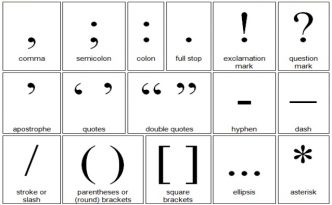
Have you ever read a written material and just couldn’t figure out the mood it carried? Or have you ever been sent an email that infuriated you because it sounded arrogant and questioning, with countless alternating exclamation and question marks? Or were you stuck somewhere in a sentence, not knowing the exact point, because the commas were misplaced? It’s sad, but no matter how well you can put magic into words, they will only be futile if you cannot punctuate them properly.

In spoken language, we raise our voice when we are surprised or angry. Our tone rises towards the end when we ask a yes/no question. We have short pauses between phrases or group of words, and longer pauses between complete sentences. When writing, however, it is more challenging to communicate these pauses and emotions. Thus punctuation marks make our lives easier.
Here’s a tip: In professional writing, such as in contracts, research papers and formal articles, exclamation points (!) must never be used. This is because these types of materials are supposed to be devoid of emotion, because they are objective. You don’t say “Chlorophyll gives the green color in plants!” unless you’d like to project that you were surprised about this fact.

Also, what’s the deal with commas? Commas are used to separate items in a series. They are also used to separate phrases in sentences. If you were reading aloud, it would warrant a short pause. Where you place the comma can change the meaning of a sentence. For example: “My sister, Chloe, and Nathan went to the party” means you’re talking about 3 people. But “My sister Chloe, and Nathan, went to the party” means you are referring to 2.

Do your research if you’re not sure how to use symbols, and make your written materials more appropriate by using them.

How to Avoid Plagiarism: Essential Tips

June 6, 2010 by · Leave a Comment 

Today, the Internet is filled with people looking to earn some money by becoming freelance writers. While this has been a good circumstance for many, it has also shed some light on one of the challenges being faced by writers these days – plagiarism. Simply put, plagiarism is stealing someone else’s written work or part of it and claiming it as one’s own. In essence, it is taking advantage of someone’s ideas without giving credit to the person who came up with it. It is outright intellectual theft, and it’s not good for business. Besides, you wouldn’t want someone else stealing your work and gaining credit for it. While others may knowingly do this in an attempt to earn quick money, others may not be aware they are actually committing plagiarism. If you are a writer, you ought to protect yourself at all costs. Here’s how you can avoid committing plagiarism:

First, manage time wisely. Many people resort to plagiarism because they lack time to research and think of their own words. When you are researching, learn the art of paraphrasing. This means using your own words to communicate what a passage is saying. Also, be sure you take references seriously. If you get a piece of information from a website, be sure to take note of the site and if possible, include it as reference in your material. If you are going to use a line or two, word after word, you will need quotation marks. Quoting means someone else said it, not you. If you are omitting, you can use ellipses for the parts you are not including. For instance, “This the age of cynicism… so we must go on.” Finally, use online programs to check for plagiarism. The most common ones are PlagiarismDetect and Copyscape.

How to Get Paid for your Articles

May 6, 2010 by · Leave a Comment 

If you have a way with words, why not invest in it? More and more people are discovering the joys and rewards of freelance writing. Instead of writing for yourself, write for other people who will enjoy reading your articles. Best of all, you have be a freelance writer without disrupting your current lifestyle, or you could say goodbye to your place behind the desk and work conveniently from home. Here are some friendly tips on how to get paid for your articles.

Know your expertise.

Good writers are great wherever you put them, but if you are going to make money out of writing, you’d rather write on topics you are most passionate about. This way, it won’t feel much like a task. Lots of writers complain of writer’s block, or the inability to find the words for a written piece. If you know a lot about a topic, and are passionate about researching, you can get away from this challenge easily.

Know where to submit your articles.

Once you have decided on which topics you’d like to concentrate on, you can now choose where you’d like to submit your articles to. Websites like Squidoo and Associated Content are popular among freelance writers. While you don’t get paid for writing per se, you will earn a percentage of advertising fees every time your article is viewed.

Join a writing team.

If you would like to be spared the trouble of looking for people who will buy your articles, you can join a ghostwriting team which already usually has a list of clients their members write for. Ghostwriting means you won’t have rights to the articles, but you will get a good price for your material.

Sign up at an online job marketplace.

Elance and Freelancer are two common online marketplaces where writers and other freelancers meet buyers who are willing to pay for writing services. Discover how you can maximize your potentials by browsing a large database of jobs and finding the one that best suits your qualifications.

Mistakes to Avoid when Freelance Writing

April 6, 2010 by · Leave a Comment 

Once you have made a decision to become a freelance writer, you will need to learn how to make your writing business gain positive light. Freelance writing newbies often commit mistakes that send their chances spiraling down the drain. Here are just some of them:

Plagiarizing
This is the mortal sin of all writing, freelance or not. This basically happens when you steal someone else’s ideas and make it your own, getting credit for someone you did not work hard on. When you plagiarize, you are hurting someone else’s business, but are hurting yours even more. You could be blacklisted and may have a harder time applying for freelance writing jobs. To avoid this, do adequate research and learn how to substitute words and phrases with your own, a process called paraphrasing.

Being incoherent
Never be in a hurry to make some money out of your articles. A common mistake is writing pointlessly, without a proper introduction, body and conclusion. As a result, the reader is confused and may not be driven to believe what your article is saying.

Taking grammar and spelling loosely
No matter how well you write, you will definitely lose customers and readers if you don’t perform a spell-check and proofread your articles before submission. Bad grammar and spelling tells a reader you are not professional and not credible enough.

Writing bad titles
The title, or the headline of your articles are always the attention-grabbers. But if you write lame titles, don’t expect your articles to get any attention. Write titles in the form of a question, and make sure it implies a benefit to the reader. Otherwise, the reader will be left thinking, “What’s in it for me?” and will move on if they don’t find anything interesting about the title.

Choosing bad keywords
Finally, if you are SEO-writing, you will need to know that the income of your articles will depend on how well it does on search engines. So, before you write an article, choose a set of strong keywords that will help your articles land on a high place in several search engines.

Some of these things they don’t teach you at school, so it takes experience and research to learn.

Tips for Writing the Best Cover Letter

March 6, 2010 by · Leave a Comment 

Getting a job these days isn’t exactly rocket science, but it’s also not the easier thing to do. With competitive fresh graduates eager to climb the corporate ladder and the job market narrowing its prospects due to recession, how do you make sure your resume ends up in the “shortlist” pile? Most employers now utilize an online application wherein you send a cover letter and comprehensive resume through email. They review your application and get back to you if they like what they see? Many applicants pour all efforts into an awesome resume, but leave little room for a cover letter. The cover letter is termed such because it functions as an introductory page, like a sales proposal, before an employer flips to read your resume, which are but details. Therefore, it has to be well-written and competitive. Here are some tips for writing the best cover letter and ultimately scoring your dream job.

1. Never say “Dear Sir” if you know the name of the person you can address it to. Do a little research and find out the person responsible for the recruitment process.

2. Never fill the page with fluff. Be concise, because less is more. As a guide, limit your letter to three paragraphs. The first one talks about where you found the job ad and why you are interested. The second should highlight your education background and experience. The third can be used as closing. Be sure to include how you can be contacted.

3. Sell yourself – focus on why you should be hired, but be realistic. Choose words that are enthusiastic and passionate, but not exaggerated.

4. Express initiative. Let the employer know you would like to set up an interview to discuss your application further.

5. Finally, include your contact details and let the employer know you may be reached at their convenience.